

Fields Medalist Laurent Lafforgue Deliveres a Lecture as Part of the Nankai University Chern Lecture Series
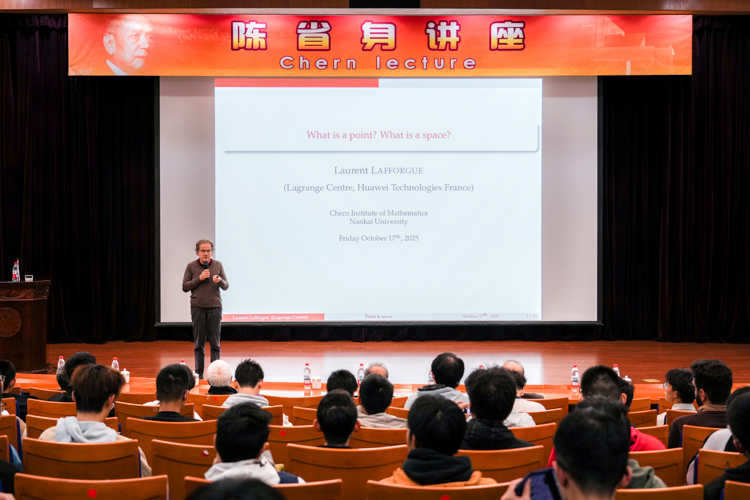
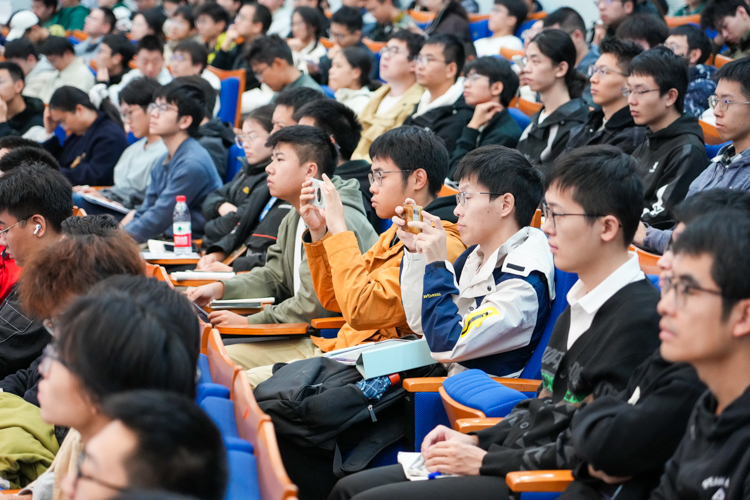
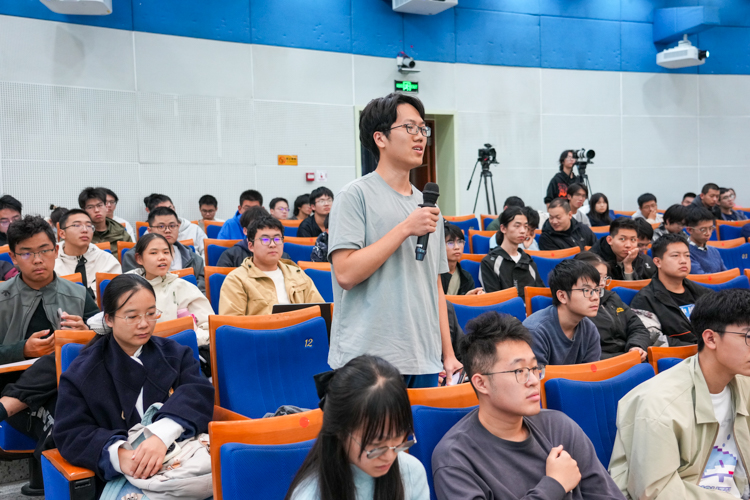
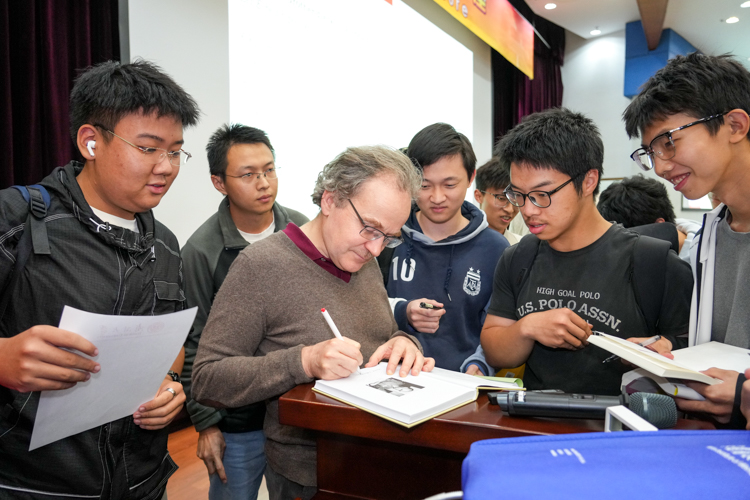
On October 17, Laurent Lafforgue, the 2002 Fields Medalist, Member of the French Academy of Sciences, recipient of the 2025 Chinese Government Friendship Award, and Senior Expert at Lagrange Centre, Huawei Technologies France, was invited to deliver a lecture titled “What is a point? What is a space?” as part of the Chern Lecture Series at the Chern Institute of Mathematics.
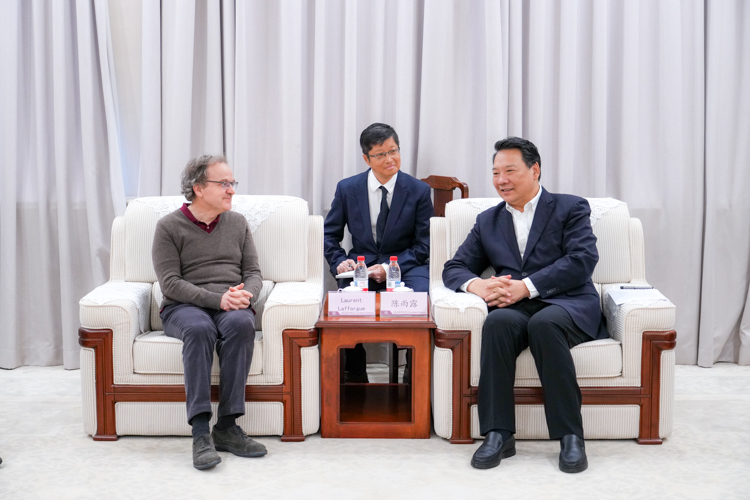
Prior to the lecture, Nankai University (NKU) President Chen Yulu met with Prof. Lafforgue at Shiing-Shen Building. The meeting was also attended by Bai Chengming, Vice President of NKU and Director of the Chern Institute of Mathematics; Long Yiming, Academician of the Chinese Academy of Sciences and Professor at the Chern Institute of Mathematics; as well as several faculty members from the Chern Institute of Mathematics.
President Chen extended sincere welcome to Prof. Lafforgue for his participation in the Chern Lecture Series on the occasion of NKU’s 106th anniversary. Prof. Lafforgue is a world-renowned mathematician with groundbreaking contributions to topos theory and its potential applications in communications, artificial intelligence, and other fields. President Chen reaffirmed NKU’s commitment to advancing the development and interdisciplinary integration of mathematics and artificial intelligence. He expressed his hope that Prof. Lafforgue would share insights from Sino-French collaborative training of mathematical talent, provide guidance on disciplinary development and talent cultivation, and deepen cooperation with NKU on disciplinary development.
Prof. Lafforgue expressed his gratitude to NKU for the gracious hospitality. Since 2019, he has engaged in multiple productive Sino-French mathematical talent training collaborations with Ma Xiaonan, Chair Professor at the Chern Institute of Mathematics, in programs such as the China-France Mathematics Talents Class at the University of Science and Technology of China. He remarked that he was much impressed by the exceptional learning attributes and boundless potential demonstrated by Chinese mathematics scholars. Prof. Lafforgue expressed his hope that this visit would inaugurate a new phase of exchange and cooperation between the Chinese and French mathematical communities in frontier theoretical research, interdisciplinary innovation, and the cultivation of young talent, thereby elevating mathematics to new heights.
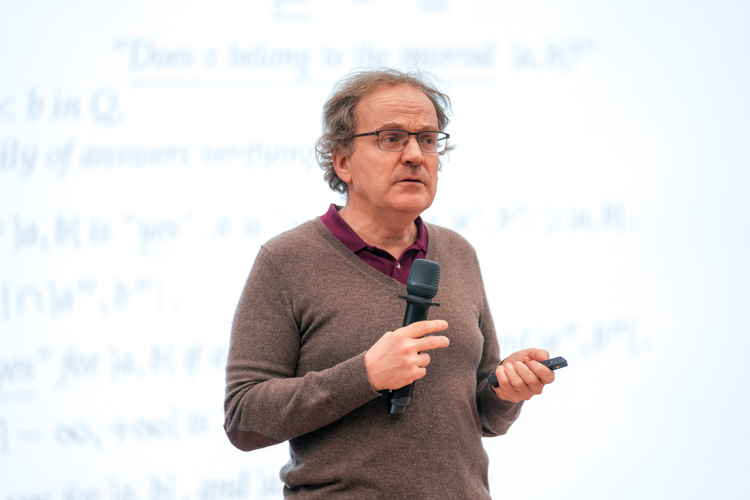
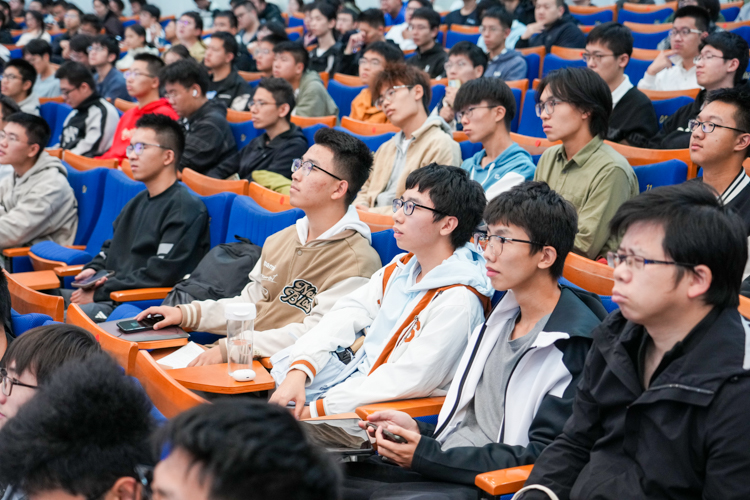
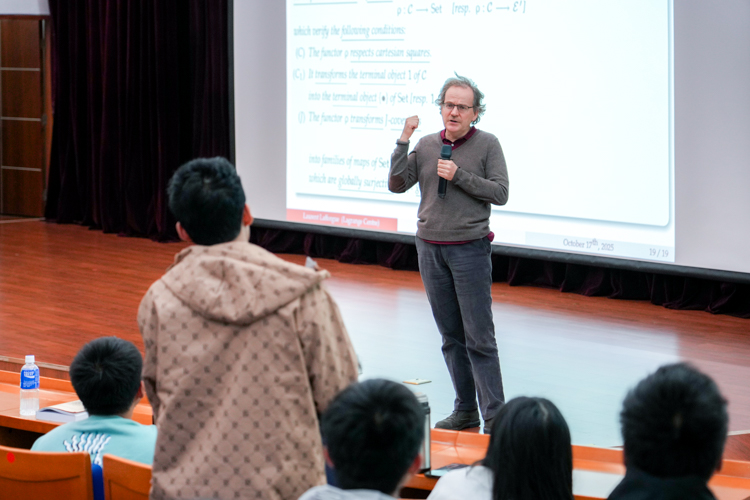
In his lecture, Prof. Lafforgue proposed a novel perspective: A real number can be viewed as a logically self-consistent Q&A system about “whether a number falls within a specific interval.” Much like guessing a number by progressively narrowing its range, this process uniquely determines the number itself. By introducing concepts such as covering and Grothendieck topologies, he explored the notion of “points” on more general sets. In this framework, a “point” is no longer the familiar dot but rather a “rule interpreter” capable of decoding the entire structure of the space. Through a rigorous system of correspondences, it translates complex mathematical objects into comprehensible set-theoretic information.
Prof. Lafforgue particularly emphasized that for the spaces we are familiar with, the “points” defined by this method correspond perfectly with those in the traditional understanding. More intriguingly, when he used “measure” (a tool for quantifying size) to describe a “point,” he found that only locations with “substantial presence” would be recognized as a “point.” He extended this theory to the more abstract framework of Cartesian categories, ultimately leading to the concept of a “topos” in modern mathematics. He pointed out that the previously defined “points” remain valid within topos theory and hold broader mathematical significance.
(Edited and translated by Nankai News Team.)

38 Tongyan Road, Jinnan District, Tianjin, P.R.China 300350 94 Weijin Road, Nankai District, Tianjin, P.R.China 300071
Copyright: Nankai University All Rights Reserved