

A Research Team from Nankai University Reports Breakthrough in Precision Measurements of Phi Mesons and Neutral Kaons
On October 15, Prof. Zhao Minggang from the School of Physics, Nankai University (NKU), in collaboration with Prof. Dong Liaoyuan and Li Haibo from the Institute of High Energy Physics, Chinese Academy of Sciences, as well as Prof. Ke Baiqian from Zhengzhou University, achieved a breakthrough in experimental measurements of low-energy QCD, based on data samples collected near the strange-charmed meson threshold by the BESIII experiment. The related findings, entitled “Study of φ→K⁺K⁻ and K_S^0-K_L^0 Asymmetry in the Amplitude Analysis of D_s^+→K_S^0 K_L^0 π^+ Decays,” have been published in Physical Review Letters, a top-tier journal in the field of physics.
Based on electron and positron annihilation data at center-of-mass energies between 4.178–4.226 GeV, the BESIII collaboration measured the branching fraction of D_s^+ → ϕπ^+, ϕ→K_S^0 K_L^0 through an amplitude analysis of D_s^+ → K_S^0 K_L^0 π^+. The analysis yields R_ϕ = 0.593 ± 0.023(stat) ± 0.014(syst) ± 0.016(ϕπ), which deviates from the world average value by more than three standard deviations. This result will have a significant impact on the foundational inputs for studies related to non-perturbative QCD, the structures of hadronic matters, and CP violation. The figure below shows the invariant mass projections from the amplitude analysis and comparison of R_ϕ result. The figure below presents the invariant mass projections from the amplitude analysis and a comparison of the R_ϕ results.
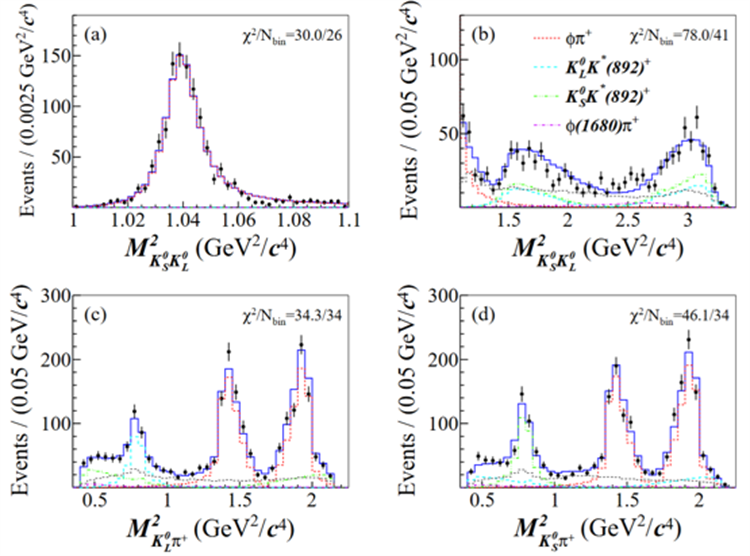
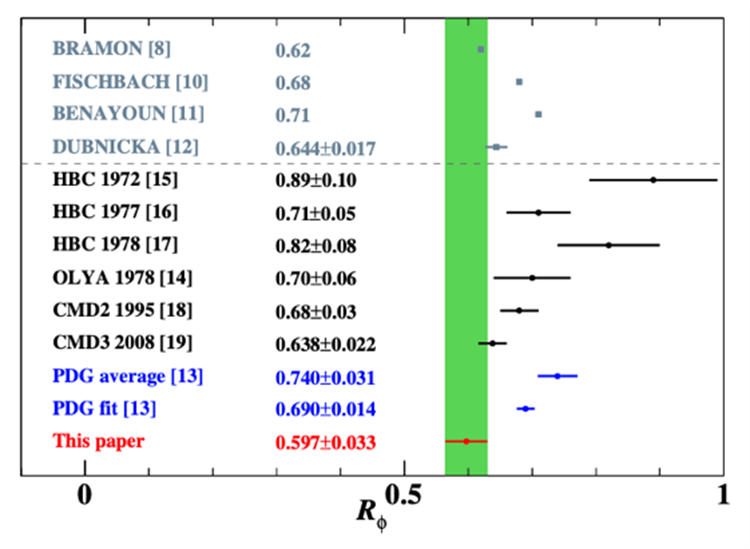
Fig. 1. (Top) The projections on invariant mass of the amplitude analysis results. (Bottom) Comparison of R_ϕ measured in this Letter with the existed experimental and theoretical results.
Read the paper at
https://journals.aps.org/prl/abstract/10.1103/6py9-h8qv.
(Edited and translated by Nankai News Team.)

38 Tongyan Road, Jinnan District, Tianjin, P.R.China 300350 94 Weijin Road, Nankai District, Tianjin, P.R.China 300071
Copyright: Nankai University All Rights Reserved