


Nankai University Team Discovers New Target for Infertility Treatment
A pioneering study by the Developmental Biology and Stem Cell Team from the College of Life Sciences and the State Key Laboratory of Medicinal Chemical Biology at Nankai University has brought new hope to women experiencing infertility due to age or unexplained causes. The research uncovered the age-related molecular clock—ribosomal dysregulation—behind the decline in female fertility after the age of 34. It also preliminarily validates that rapamycin may serve as a potential, safe, and effective treatment to help patients with repeated in vitro fertilization (IVF) failures achieve successful pregnancy and live births. This suggests that rapamycin may represent a breakthrough in infertility treatment.
This significant research was conducted jointly by the Nankai University team in collaboration with Shanxi Children’s Hospital (Shanxi Women and Children Hospital), the Sixth Medical Center of PLA General Hospital, and Tianjin Medical University General Hospital. The findings have been published in the internationally renowned journal Cell Reports Medicine.
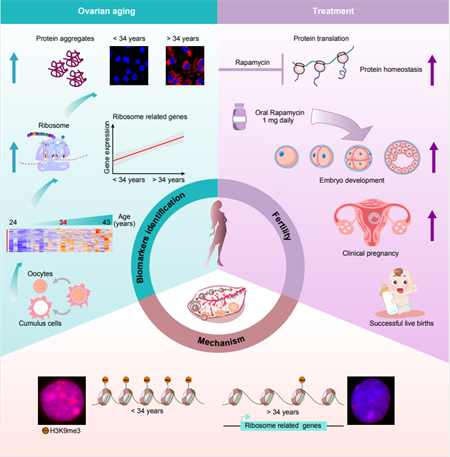
Schematic Diagram of the Research Mechanism
The research indicates that once women reach the age of 34, significant transcriptomic changes occur in their oocytes and surrounding cumulus cells. One of the most prominent features is the abnormal elevation in the transcription levels of ribosomal genes. At the same time, consistent with previously reported results, the expression levels of genes related to meiosis, actin, and cohesin in oocytes are down-regulated. Additionally, the lysosomal activity in cumulus cells decreases and protein homeostasis becomes disrupted.
“Our work shows that abnormal ribosomal function is a previously overlooked driver of oocyte quality decline. This is not only an issue within the oocyte itself, but the surrounding cumulus cells have also undergone similar changes. Together, they impair the developmental potential of oocytes and embryos,” said Li Jie, the first author of the paper and a 2020 doctoral graduate in Cell Biology from Nankai University.
Further mechanistic research reveals that the “overactivity” of ribosomal genes is closely related to epigenetic dysregulation: specific genomic sites exhibit DNA hypomethylation and localized reduction of heterochromatin H3K9me3. This disruption in the nuclear regulatory system that governs gene “switches” leads to abnormally high ribosomal gene expression and increased aberrant protein synthesis.
Based on these findings, the research team conducted mouse intervention experiments using rapamycin, a drug known for inhibiting mTOR and ribosomal translation, slowing aging processes, and widely used in immune rejection suppression. The results showed that rapamycin effectively reduces overall translational activity within cells and restores protein homeostasis, thereby improving the ovarian microenvironment and oocyte quality.
Encouragingly, this research has been validated in clinical trials. Guided by the aforementioned mechanisms, the research team conducted a randomized controlled trial, confirming that short-term rapamycin treatment enables patients with repeated IVF failures and embryonic developmental arrest to obtain high-quality blastocysts and successfully achieve pregnancy and live births.
Link to the paper:
https://www.cell.com/cell-reports-medicine/fulltext/S2666-3791(25)00497-5
(Edited and translated by Nankai News Team.)

38 Tongyan Road, Jinnan District, Tianjin, P.R.China 300350 94 Weijin Road, Nankai District, Tianjin, P.R.China 300071
Copyright: Nankai University All Rights Reserved