

A Research Team from Nankai University Announces Critical Advances in Activating Totipotency in Embryonic Stem Cells
Recently, a research team led by Prof. Shuai Ling from the State Key Laboratory of Medicinal Chemical Biology, Nankai University (NKU) discovered that overexpression of the key gene Hmgn3 in mouse embryonic stem cells can effectively activate the cells’ developmental totipotency, a process functioning through interaction with its downstream Dux gene family. This study provides novel strategies and models for research in early embryonic development and regenerative medicine. The related findings, entitled “Hmgn3 is critical for inducing totipotency in mouse embryonic stem cells,” have been published in Science Bulletin, a prestigious scientific journal of the Chinese Academy of Sciences.
The research team successfully established an Hmgn3-OE ESCs, which exhibited higher cellular plasticity than wild-type ESCs. Chimera formation assays demonstrated that Hmgn3 overexpression enabled these cells to stably contribute to fetal, placental, and yolk sac tissues in vivo, whereas knockout of its downstream key gene Dux severely compromised this capability. Moreover, the blastoids efficiently self-organized from Hmgn3-OE ESCs in vitro displayed cellular, molecular, and developmental characteristics highly similar to wild-type blastocysts, thus further confirming their totipotent potential. These findings underscore the potent potential of Hmgn3 as a single gene in inducing stem cell totipotency and constructing artificial embryo models. The study provides a novel and efficient platform for expanding the differentiation potential of stem cells and regulating early embryonic development.
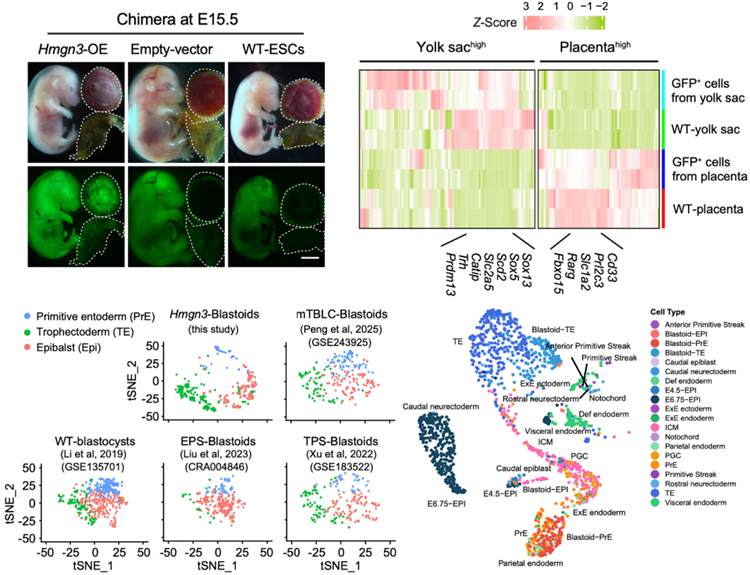
Fig. Hmgn3 plays a vital role in inducing totipotency in stem cells
This study has unveiled the pivotal role of Hmgn3 as a “master regulator of totipotency,” and offers a novel perspective on the regulatory network governing early mammalian development. “Compared to complex chemical induction methods, this single-gene induction strategy is more straightforward and efficient. The resulting synthetic embryo models will provide an ideal in vitro platform for drug screening and research on developmental disorders,” stated Prof. Shuai Ling.
Prof. Shuai Ling, Dr. Gao Qian, Associate Professor Zhang Wenhao from the NKU State Key Laboratory of Medicinal Chemical Biology, and Zhang Yamin, Vice President of Tianjin First Central Hospital, served as co-corresponding authors of the paper.
Read the paper at https://www.sciencedirect.com/science/article/pii/S2095927325010473
(Edited and translated by Nankai News Team.)

38 Tongyan Road, Jinnan District, Tianjin, P.R.China 300350 94 Weijin Road, Nankai District, Tianjin, P.R.China 300071
Copyright: Nankai University All Rights Reserved