

Nankai University Research Team Contributes to Groundbreaking Study Published in Nature
Recently, Xiangpan Ji, Associate Professor at the School of Physics, Nankai University (NKU), in collaboration with Brookhaven National Laboratory physicist Jay Hyun Jo and Louisiana State University professor Hanyu Wei, used data from MicroBooNE at Fermilab to achieve a major breakthrough in the study of sterile neutrinos. The study pioneered an innovative “single detector + two neutrino beams” approach, excluding the existence of a single sterile neutrino at a 95% confidence level. Their findings, titled “Search for Light Sterile Neutrinos with Two Neutrino Beams at MicroBooNE,” have been published in the prestigious journal Nature.
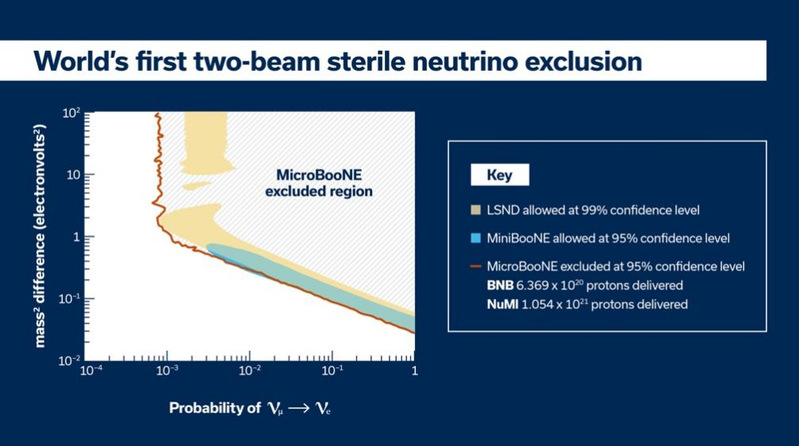
Fig.1. Previous experiments indicated where a fourth neutrino may be observed. MicroBooNE scientists have ruled out the region where a single sterile neutrino may have been found with 95% certainty. The collaboration combined data collected from two different neutrino beams to achieve this result. Credit: MicroBooNE collaboration
MicroBooNE is an accelerator-based neutrino experiment at Fermilab in the United States. Its main detector is a liquid argon time projection chamber, measures interactions between neutrinos produced by the accelerator and the detector target argons. The MicroBooNE international collaboration comprises approximately 200 scientists from 40 research institutions across six countries. The NKU research group led by Prof. Ji is its sole member institution from Asia.
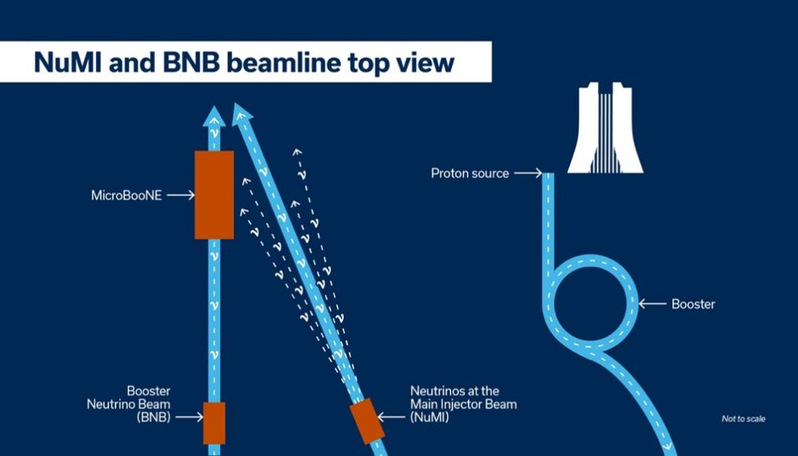
Fig. 2. For this result, MicroBooNE observed neutrinos from both the Booster Neutrino Beam (BNB) and NuMI. Credit: Samantha Koch, Fermilab
The research team leveraged the unique configuration of MicroBooNE and pioneered the “single detector + two neutrino beams” approach to significantly reduce systematic uncertainties and overcome the cancellation effect between electron-neutrino appearance and disappearance. Their findings exclude the parameter space for a single sterile neutrino proposed by the LSND and MiniBooNE experiments at a 95% confidence level. Concurrently, the results rule out a majority of the parameter space suggested by the GALLEX/SAGE/BEST and Neutrino-4 experiments at the same confidence level. This shows that the MicroBooNE results rule out the single sterile neutrino model.
This result used just 60% of MicroBooNE’s total data set. Now the research team has initiated the next phase of research, which will integrate artificial intelligence technology, new analysis methods, and the complete experimental dataset to further advance research in neutrino physics.
“The Nankai University team, led by Prof. Ji, one of the co-leaders of the paper, made significant contributions to the conceptualization, analysis procedure, software, and statistical analyses. These contributions were essential to the overall analysis and findings of the publication.” said Matthew Toups, co-spokesperson of the MicroBooNE collaboration, senior scientist at Fermilab, and Fellow of the American Physical Society.
Read the paper at https://doi.org/10.1038/s41586-025-09757-7.
(Edited and translated by Nankai News Team.)

38 Tongyan Road, Jinnan District, Tianjin, P.R.China 300350 94 Weijin Road, Nankai District, Tianjin, P.R.China 300071
Copyright: Nankai University All Rights Reserved