


Nankai University Team Achieves Breakthrough in Flexible Topological Laser Research
A research team led by Professors Zhang Xinzheng, Chen Zhigang, and Xu Jingjun from the School of Physics at Nankai University, in collaboration with Professor Irena Drevenšek Olenik from the Jožef Stefan Institute in Slovenia, has demonstrated for the first time a circularly polarized flexible topological vertical-cavity surface-emitting laser (VCSEL) with high laser conversion efficiency. The findings have been published in Light: Science & Applications under the title “Soft-Matter-Based Topological Vertical Cavity Surface Emitting Lasers”.
The reported topological VCSEL is based on a one-dimensional optical superlattice composed of polymer cholesteric liquid crystal (PCLC) films spin-coated with a fluorescent gain medium and stacked alternately with commercial Mylar films. The superlattice features a modulated on-site potential that breaks inversion symmetry, which can be analogized to the Semenov insulator in a two-dimensional synthetic parameter space and to the Quantum Valley Hall effect. The researchers demonstrated that the topological VCSEL maintains excellent single-mode laser emission at low pump power. Notably, this thin-film topological VCSEL offers extremely low fabrication cost, requires no complex processing techniques, can be readily integrated onto substrates of arbitrary shapes, and preserves its laser performance and beam-steering capability even after repeated bending.
In their study, the researchers first constructed a one-dimensional binary optical superlattice by stacking PCLC films with Mylar films of two different thicknesses, thereby breaking spatial inversion symmetry. By introducing coupling-coefficient modulation to build a synthetic parameter space, they established an analogy with the Quantum Valley Hall Effect in a two-dimensional hexagonal lattice and clarified the topological distinction between AB and BA superlattices with hetero-site potentials. By subsequently splicing AB and BA superlattices with distinct topological properties, a topologically protected interface state was formed. This interface state is highly localized within the bandgap and exhibits robustness against structural disorder, providing an ideal optical cavity mode for laser oscillation. Experimentally, the team fabricated a flexible sample of the topological VCSEL consisting of 17 thin-film layers and spin-coating the gain dye PM597 onto the PCLC film. Under pulsed optical pumping at 532 nm, the device achieved left-handed circularly polarized topological laser emission at 575.4 nm, with an ultralow threshold of 0.47 μJ (1.5 MW·cm-2) and a slope efficiency of 4.0%. The emitted laser beam exhibits good directionality, and its spatial profile closely matches the pump spot, highlighting its potential for applications in image transmission and display. Furthermore, with the pump laser direction fixed, the researchers bent the flexible film and translated it vertically, allowing the pump beam to illuminate five different regions (I–V) of the sample. The emitted laser spot correspondingly shifted upward on the projection screen. By adjusting the curvature radius of the VCSEL film, the beam-steering angle could be further tuned. This capability enables multi-angle laser emission without physically rotating the device. Importantly, the topological VCSEL exhibits excellent thermal stability, maintaining its original laser performance even after prolonged pumping. These properties make it well-suited for integration with wearable photonic devices, enabling applications such as wearable displays, electronic anti-counterfeiting, and laser scanning.
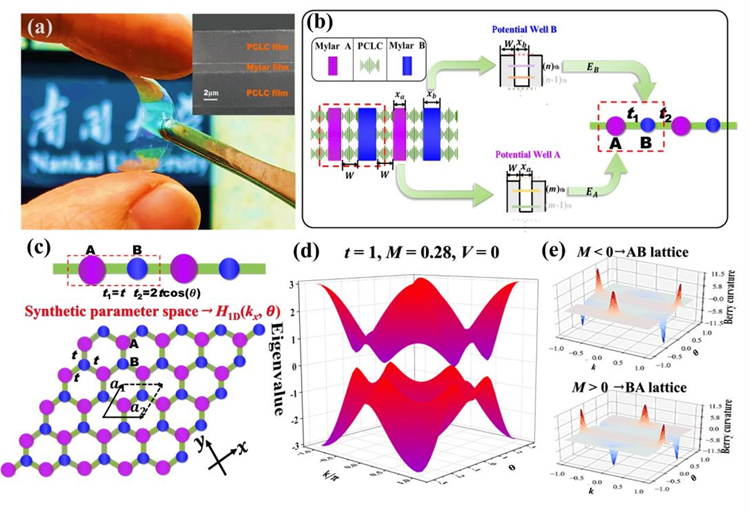
Basic construction principle of the one-dimensional flexible optical superlattice and the synthetic parameter space
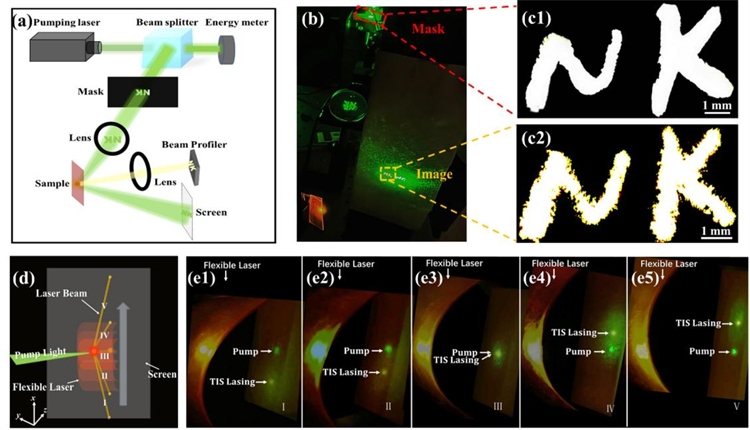
Application demonstrations of the flexible topological VCSEL
This work was completed under the primary affiliation of Nankai University. Postdoctoral researcher Wang Yu and Professor Xia Shiqi of Nankai University are co-first authors of the paper. Professors Zhang Xinzheng, Chen Zhigang, and Xu Jingjun are the corresponding authors.
Link to the paper: https://www.nature.com/articles/s41377-025-02011-9
(Edited and translated by Nankai News Team.)

38 Tongyan Road, Jinnan District, Tianjin, P.R.China 300350 94 Weijin Road, Nankai District, Tianjin, P.R.China 300071
Copyright: Nankai University All Rights Reserved