

Nankai University Announces 15 High-Value Research Projects for Commercialization
On January 13, a matchmaking event for the commercialization of research projects was held at Tiankai Higher Education Innovation Park. Cui Zhenping, Secretary of the Party Committee and Director General of the Tianjin Municipal Science and Technology Bureau, attended the event. Fang Yongchun, Vice President of Nankai University, announced 15 high-value research projects for commercialization.
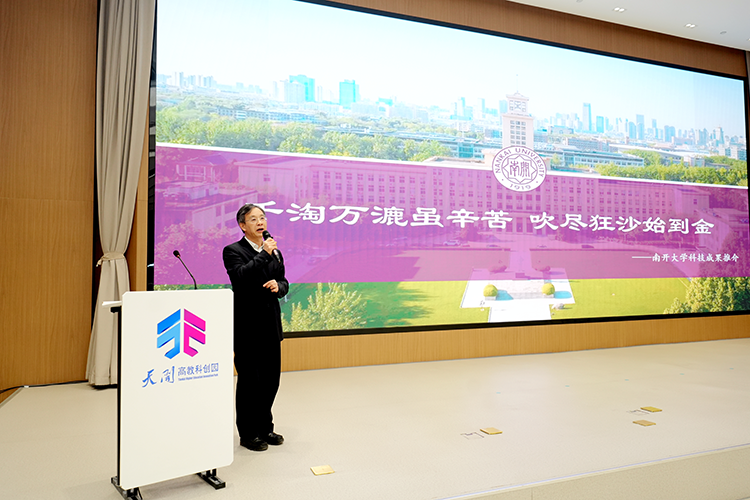
At the event, Fang Yongchun highlighted Nankai University’s overall progress in deeply integrating into the development of the Innovation Park by strengthening institutional safeguards, expanding capital support, and consolidating talent reserve to enhance the commercialization of research projects. On this basis, he announced 15 high-value research projects spanning cutting-edge fields including biomedicine and artificial intelligence. Half of the projects originate from the State Key Laboratory of Medicinal Chemical Biology, underscoring the university’s capacity for pioneering innovation.
The 15 projects include: bioartificial blood vessels from Kong Deling’s team, small-molecule drugs for colorectal cancer from Lu Zhaoyong’s team, nanoscale stem cell culture media from Xue Xue’s team, single-molecule detection instrument for the aging biomarker telomere length from Yu Zhongbo’s team, an antigen-clearing antibody that effectively removes circulating IgE and allergens from Zhang Hongkai’s team, mitochondria-targeting drugs for treating muscle-related diseases from Chen Guo’s team, edible and medicinal traditional Chinese medicine nanoparticles and an efficacy validation platform for novel composite formulations from Jia Zhenghu’s team, immunoactive microbial polysaccharides from Ma Ting’s team, biomimetic rotator cuff patches promoting tendon-bone interface repair and regeneration from Wang Shufang’s team, the Qifu biomimetic stem cell tissue engineering platform from Yang Jun’s team, a modular platform for efficient asymmetric synthesis of H-phosphonamides to construct P(V)-chiral compounds from Su Bo’s team, educational and medical agents and smart devices based on vertical-domain large models from Liu Yin’s team, a whole-life-cycle intelligent screening and intervention system for autism from Wang Chongying’s team, cross-domain embodied perception and behavior optimization for intelligent unmanned systems from Wang Hongpeng’s team, and low-carbon synergistic utilization of multi-source organic solid waste and iron and steel solid waste from Yu Kai’s team.
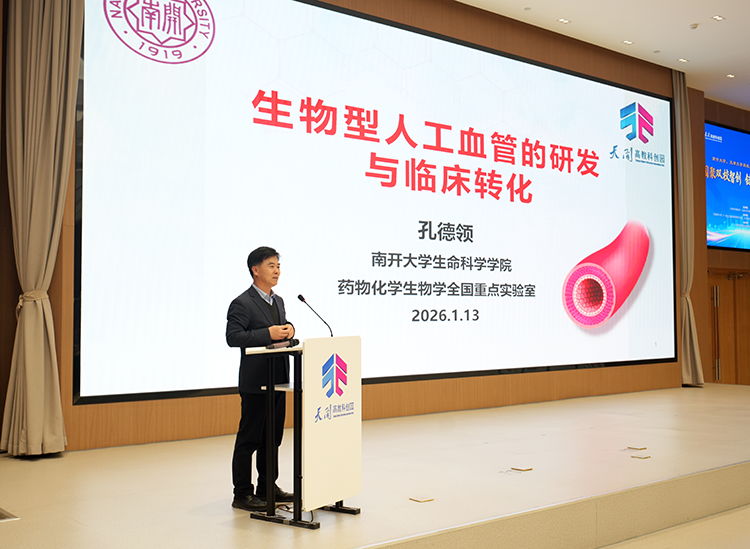
Speaking on behalf of Nankai University’s research teams, Professor Kong Deling delivered a keynote address on his team’s bioartificial blood vessel project. He said its first application scenario focuses on vascular access for hemodialysis, and that participation in the event was intended to connect with investors and leading industry partners to seek collaboration and funding support. He added that, if funding and favorable conditions can be secured in Tianjin, the team plans to implement the project locally and advance its industrialization.
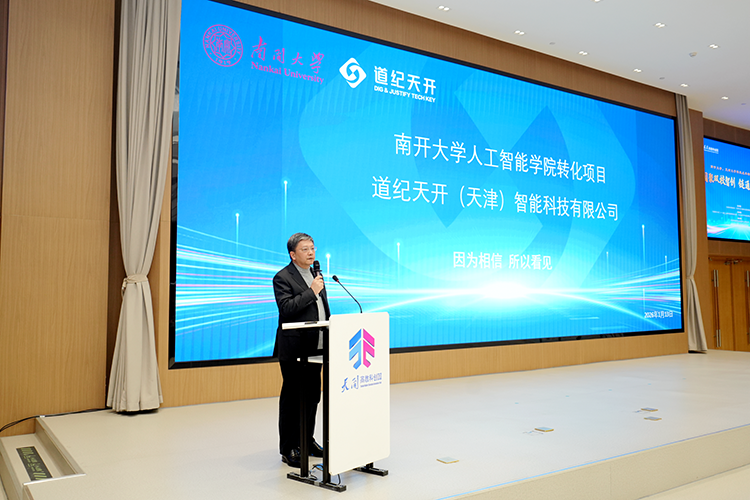
Zhang Yu, CEO of Daoji Tiankai (Tianjin) Intelligent Technology Co., Ltd., a Nankai University-affiliated company in the Innovation Park, shared updates on the company’s projects and his experience in building a business there. He noted the Innovation Park’s innovation ecosystem and policy support provide fertile ground for the commercialization of universities’ research projects, helping entrepreneurs build sustainable ventures.
Tiankai Higher Education Innovation Park now covers 98.89 square kilometers under a “one core, two wings, multiple points” development layout. It has incubated or attracted more than 4,500 technology-based companies. Among them, more than 200 have been started or commercialized by Nankai University’s faculty, students, and alumni, making them a key force driving regional innovation and development.
(Edited and translated by Nankai News Team.)

38 Tongyan Road, Jinnan District, Tianjin, P.R.China 300350 94 Weijin Road, Nankai District, Tianjin, P.R.China 300071
Copyright: Nankai University All Rights Reserved