

Chen Yulu Attends the First Meeting of the Advisory Committee of the China–SCO Green Industry Cooperation Platform
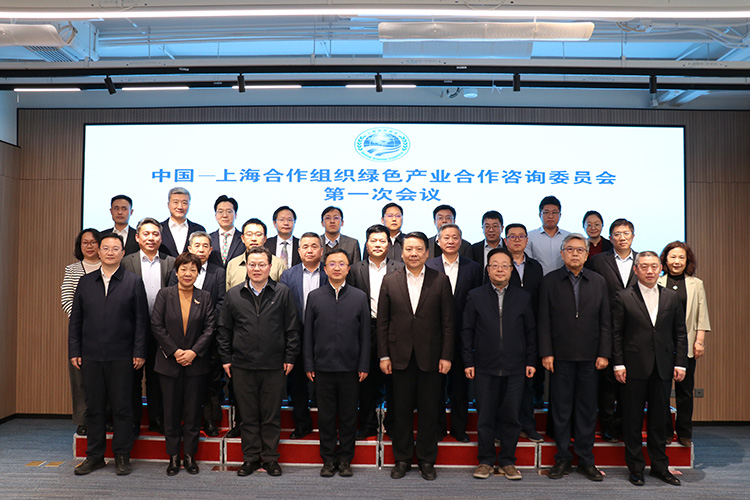
Recently, guided by the National Development and Reform Commission (NDRC), the first meeting of the Advisory Committee of the China–SCO Green Industry Cooperation Platform was held in Beijing. The meeting was attended by and featured remarks from Zhang Lupeng, Deputy Director-General of the Department of Resource Conservation and Environmental Protection of the NDRC; Chen Yulu, Vice Chairman of the 14th National People’s Congress Financial and Economic Affairs Committee and President of Nankai University; He Kebin, Academician of the Chinese Academy of Engineering and Dean of Tsinghua University’s Institute for Carbon Neutrality; Wu Hongliang, Director General of the International Cooperation Center of the NDRC; and Liu Tao, Deputy Director of Tianjin Development and Reform Commission. At the meeting, Zhang Lupeng presented appointment letters to committee members on behalf of the NDRC. Chen Yulu, He Kebin, and Wu Hongliang were invited to serve as chairpersons of the Committee. Gong Ke, Executive Dean of the Chinese Academy of New Generation Artificial Intelligence Development Strategies and former president of Nankai University, and Wang Junfeng, Deputy Director of SCO Green Industry Research Center at Nankai University, were among 22 experts invited to serve as committee members.
In his remarks, Chen Yulu stated that the establishment of the China–SCO Green Industry Cooperation Platform is a strategic step that aligns with global sustainable development goals and deepens practical regional cooperation. He noted that Nankai University attaches great importance to the platform and views it as a major opportunity to better serve national strategies and regional development. Buiding on its traditonal strength and dictinctive features, NKU will actively support the platform's planning and the development of related mechanisms, such as the Advisory Committee, the Cooperation Alliance, and the Cooperation Facilitation Center. An operational research center has been established at Nankai University to provide direct think-tank support for China–SCO Green Industry Cooperation Platform. Going forward, the university will focus on strengthening strategic research and policy advisory services, improving talent cultivation and exchange models, and expanding international academic cooperation and cultural exchange and mutual learning to support high-quality development of the platform.
During the thematic discussion session, expert members including Gong Ke; Lyu Wenbin, Director General of the Energy Research Institute of the NDRC; Wang Xuekun, head of the Chinese Academy of International Trade and Economic Cooperation under the Ministry of Commerce; Xu Huaqing, Chief Scientist of the National Center for Climate Change Strategy and International Cooperation; and Zhu Liyang, President of the China Association of Circular Economy, delivered presentations on topics such as coordinated development of digitalization and green transformation, global climate governance, green trade, circular economy cooperation, and clean energy cooperation. Participating experts engaged in active and in-depth exchanges, and put forward a number of specific and actionable recommendations on strengthening policy research and technology incubation, promoting alignment of green standards in traditional industries, supporting companies’ international cooperation on green development, and advancing talent development and capacity building in the green sector. Their insights provided valuable input for the next phase of work on the platform.
At the SCO Tianjin Summit, President Xi Jinping announced the establishment of the China–SCO Green Industry Cooperation Platform. The platform is being advanced under the leadership of the NDRC and comprises a steering committee, an advisory committee, a cooperation alliance, a cooperation facilitation center, and a development cooperation zone. The advisory committee is set up to leverage professional expertise and provide strong intellectual support for the platform, with a focus on promoting policy dialogue and information sharing, conducting research on major issues, providing professional consultation, carrying out academic exchanges and capacity-building activities, and supporting the implementation of practical cooperation outcomes.
(Edited and translated by Nankai News Team.)

38 Tongyan Road, Jinnan District, Tianjin, P.R.China 300350 94 Weijin Road, Nankai District, Tianjin, P.R.China 300071
Copyright: Nankai University All Rights Reserved