


Perovskite Photovoltaics Efficiency Breakthrough: Nankai University Reports a New Record exceeding 27% for n–i–p Perovskite Solar Cells in Nature
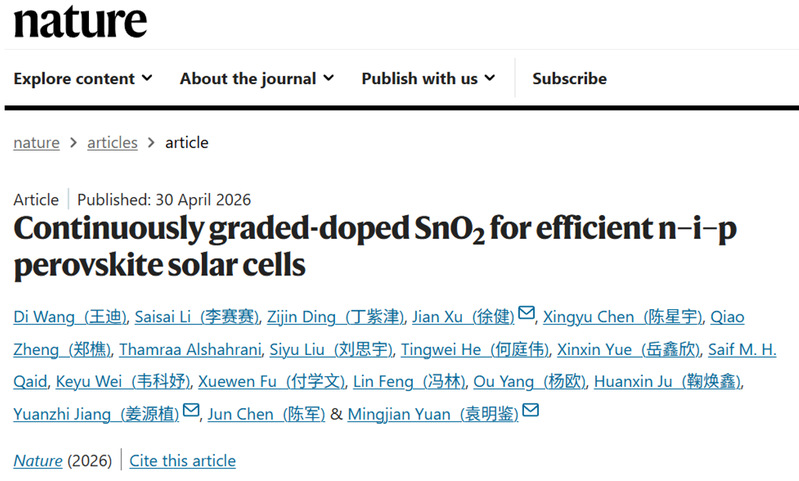
On the evening of April 30th, 2026 (Beijing time), the latest landmark research paper entitled “Continuously graded-doped SnO2 for efficient n–i–p perovskite solar cells” was published online in Nature. This achievement was jointly accomplished by the research team led by Prof. Yuan Mingjian and Prof. Jiang Yuanzhi from Nankai University, together with the research group of Dr. Xu Jian from Beijing Institute of Technology.
For the first time, the research team unraveled the core physical mechanism limiting the efficiency of n-i-p perovskite photovoltaics and innovatively proposed a design strategy for continuously gradient-doped electron transport layers (ETLs). Leveraging this strategy, the optimized device achieved a certified steady-state power conversion efficiency of 27.17% and a reverse-scan efficiency of 27.50%—both verified by internationally authoritative institutions—setting a new world record for the n-i-p perovskite solar cells.
Perovskite solar cells (PSCs) are widely recognized as a leading next-generation thin-film photovoltaic technology due to their high efficiency potential, low processing cost, and scalability, making them strong candidates for future large-scale renewable energy deployment. However, performance enhancement in n–i–p architectures has been persistently constrained by interfacial losses. Although nano-textured substrates are commonly employed to enhance optical absorption, they inevitably introduce severe interfacial non-radiative recombination losses, leading to increased voltage loss and limiting further efficiency gains. As a consequence, device efficiencies have remained stagnant at approximately 26%, while the underlying physical origins remained unclear.
Addressing this challenge, Prof. Yuan’s team combined device physics analysis with interfacial carrier dynamics to identify the fundamental loss mechanism. They demonstrate that the synergistic effect between energy band misalignment and electron accumulation at the buried interface between SnO2 ETLs and the perovskite absorber is the primary cause of non-radiative recombination loss in n–i–p devices.
Based on this insight, the team developed a chemical bath deposition (CBD)-derived n+/n continuously graded-doped SnO2 ETL. By regulating the spatial distribution of surface ligands, they achieved a doping gradient from heavily doped (n⁺) at the cathode to lightly doped (n) at the buried interface, enabling simultaneous optimization of band alignment and suppression of interfacial electron accumulation. This effectively minimizes non-radiative recombination losses at the buried interface.
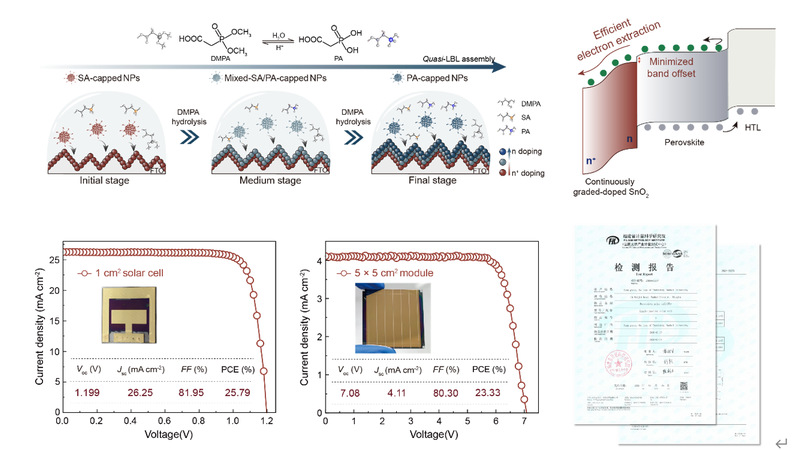
Continuously graded-doped SnO2 electron transport layer enables high-efficiency perovskite solar cells
Perovskite solar cells incorporating this newly designed electron transport layer demonstrated a certified record-breaking efficiency for n–i–p architectures. In addition, the open-circuit voltage loss was reduced to 295 mV, providing direct evidence of substantially suppressed non-radiative recombination. This work systematically clarifies long-standing ambiguities in the physical understanding of n–i–p perovskite devices and establishes a general and effective design principle for metal oxide electron transport layers. It offers a promising pathway toward high-efficiency, highly stable, and scalable perovskite photovoltaic modules.
This work was a collaborative effort between Nankai University and Beijing Institute of Technology, with Nankai University designated as the First Affiliation of the paper. Doctoral candidates Wang Di, Li Saisai, and Ding Zijin from the College of Chemistry at Nankai University served as co-first authors, while Yuan Mingjian, Jiang Yuanzhi, and Xu Jian acted as corresponding authors. Chen Jun, academician of the Chinese Academy of Sciences, provided important guidance and support in molecular structure design and the development of characterization platforms.
Link to the paper: https://doi.org/10.1038/s41586-026-10587-4
(Edited and translated by Nankai News Team.)

38 Tongyan Road, Jinnan District, Tianjin, P.R.China 300350 94 Weijin Road, Nankai District, Tianjin, P.R.China 300071
Copyright: Nankai University All Rights Reserved