

A Delegation from Ton Duc Thang University Visits Nankai University
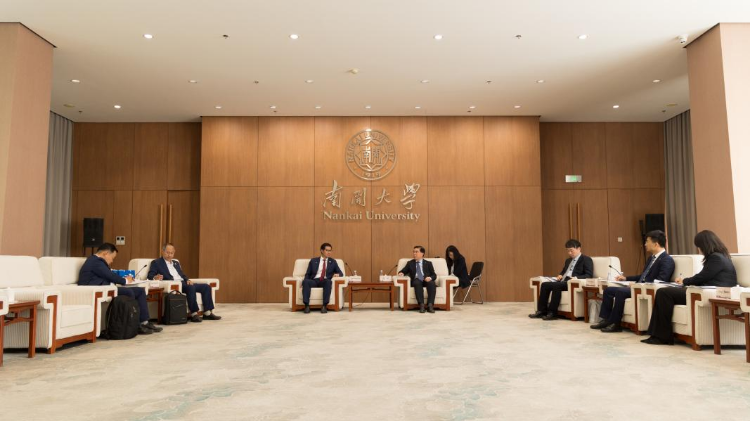
On April 15, Sheng Bin, Vice President of Nankai University, met with a delegation led by Tran Trong Dao, President of Ton Duc Thang University in Vietnam, on Balitai Campus.
Sheng Bin extended a warm welcome to Tran Trong Dao and his delegation and briefly introduced Nankai University’s educational philosophy, disciplinary structure, research strengths, and international engagement. He stated that, as To Lam, General Secretary of the Communist Party of Vietnam Central Committee and President of Vietnam, is paying a state visit to China, high-level exchanges between the two countries are expected to bring important new opportunities for cooperation in education, science and technology, as well as people-to-people and cultural exchanges. He noted that President Tran’s special visit to Nankai University, reflected a strong willingness to advance future cooperation between the two universities. Nankai University stands ready to take it as an opportunity to build on the respective strengths of both sides and continue expanding cooperation in faculty and student exchanges, joint research, youth exchanges, and talent cultivation, so as to contribute its strength to the development of China-Vietnam friendship through mutual learning and exchange.
Tran Trong Dao thanked Nankai University for its warm reception and introduced the general profile and disciplinary strengths of Ton Duc Thang University. He said that, with China–Vietnam relations continuing to improve, cooperation between universities has ushered in new opportunities for development. With its profound history, strong educational achievements, and solid foundation and extensive experience in international exchange and cooperation, Nankai University has long attracted many Vietnamese students for study and further education. He expressed hope that the two universities will build on their respective strengths to advance faculty and student exchanges, joint student programs, and research cooperation in areas such as international Chinese language education, natural sciences, and cutting-edge interdisciplinary fields, continuously expand the scope of cooperation, and deliver more substantive outcomes in inter-university collaboration.
Later that day, the delegation also visited the School of International Education for discussions. The two sides held in-depth exchanges on topics including international Chinese language education, the recruitment and cultivation of international students, and the development of cooperation mechanisms. The delegation also visited Nankai University History Exhibition.
(Edited and translated by Nankai News Team.)

38 Tongyan Road, Jinnan District, Tianjin, P.R.China 300350 94 Weijin Road, Nankai District, Tianjin, P.R.China 300071
Copyright: Nankai University All Rights Reserved