

Chinese Civilization and World Civilizations—International Academic Conference on Marxism in the 21st Century Held
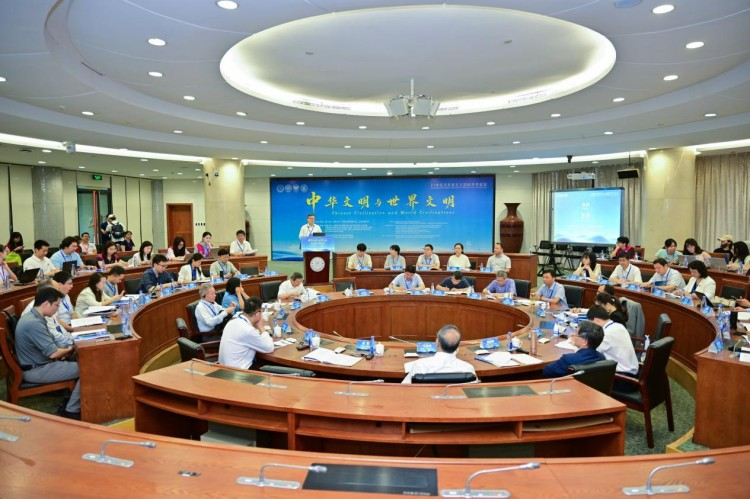
To further promote exchanges and mutual learning among different civilizations and advance theoretical and practical research on the Marxist view of civilization and the diversity of civilizations, the Chinese Civilization and World Civilizations—International Academic Conference on Marxism in the 21st Century was held at Xiamen University on June 6. The conference was co-hosted by Nankai University, Xiamen University, the University of Chinese Academy of Social Sciences, and Shanghai Jiao Tong University.
The conference was attended by Professor Wang Weiguang, a tenured professor of Nankai University and Director of the Research Institute for 21st-Century Marxism; Professor Zhang Rong, Secretary of the CPC Xiamen University Committee and an academician of the Chinese Academy of Sciences; Professor Cui Weihang, Dean of the Academy of Marxism, Chinese Academy of Social Sciences; Zhao Jianying, a professor at the University of Chinese Academy of Social Sciences and former President of China Social Sciences Press; Gao Wenshu, Vice President of the University of Chinese Academy of Social Sciences; Professor Wang Xinsheng, former Vice President of Nankai University and Dean of the School of Marxism at Nankai University; and Xu Jingong, former Deputy Secretary of the CPC Xiamen University Committee and Dean of the School of Marxism at Xiamen University. More than 50 experts and scholars from renowned universities and research institutes participated in the conference.
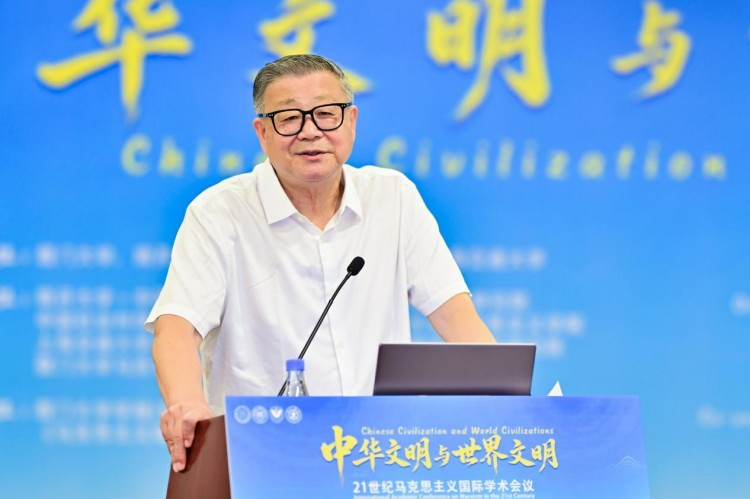
Wang Weiguang delivered a keynote speech titled “The Marxist View of Civilization and Civilization Issues”. Based on the theoretical foundation of historical materialism, Wang Weiguang, in his report, systematically elaborated on the core tenets of the Marxist view of civilization, clarified the theoretical status of civilization as a core category of historical materialism, and emphasized the need to understand the internal laws and practical issues of civilization development historically, dialectically, and concretely under the guidance of the standpoints, viewpoints, and methodology of historical materialism. Wang also systematically reviewed and presented six major scientific propositions by classical Marxist writers on civilization, which established the fundamental criteria for evaluating the nature and level of development of social civilization, and further provided an in-depth analysis of the essential characteristics and practical pathway for building the new form of civilization created by socialism with Chinese characteristics.
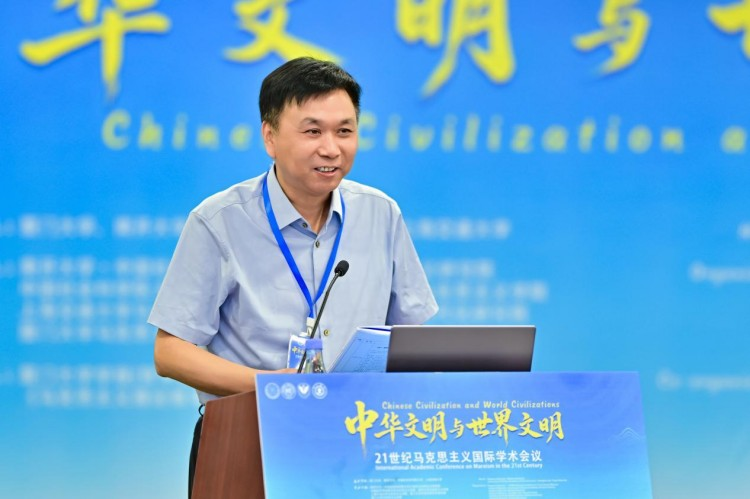
Wang Xinsheng delivered a conference report titled “Combining Theoretical Guidance with Practical Foundations as the Fundamental Path to Building China’s Independent Knowledge System”. He said that the “integration of the theoretical guidance with practical foundations” provides the methodology for building an independent knowledge system. To build China’s independent knowledge system, he noted, it is necessary to take the CPC’s continuously developing innovative theories as the fundamental guidance, base efforts on the great practice of Chinese modernization, focus on the issues of the times to advance theoretical innovation, coordinate the development of the disciplinary system, academic system, and discourse system, and work to cultivate interdisciplinary and versatile talent in philosophy and social sciences with strong political competence and solid academic foundations.
That afternoon, the Organizing Committee of the conference held a meeting and decided that the Research Institute for 21st-Century Marxism would serve as the initiating institution, and would jointly host the conference annually with Nankai University, the University of Chinese Academy of Social Sciences, Shanghai Jiao Tong University, Xiamen University, Zhejiang Normal University, and Chongqing University.
(Edited and translated by Nankai News Team.)

38 Tongyan Road, Jinnan District, Tianjin, P.R.China 300350 94 Weijin Road, Nankai District, Tianjin, P.R.China 300071
Copyright: Nankai University All Rights Reserved