

Nankai University Hosts 2026 International Conference on the Cooperation and Integration of Industry, Education, Research, and Application—Technologies for Carbon Neutrality
From September 16 to 19, the “2026 International Conference on the Cooperation and Integration of Industry, Education, Research, and Application—Technologies for Carbon Neutrality” was held at the lecture hall of the Comprehensive East Building, Jinnan Campus of Nankai University. Chen Jun, an academician of the Chinese Academy of Sciences and Executive Vice President of Nankai University, attended the conference and delivered the opening speech. Nearly 200 experts, scholars, faculty members, and students from universities and research institutions in Switzerland, the UK, Australia, Singapore, Denmark, South Korea, and China participated in the conference.
The conference was jointly hosted by Nankai University, the eScience Editorial Office, and the State Key Laboratory of Photovoltaic Materials and Cells, and was co-organized by the College of Electronic Information and Optical Engineering, the Key Laboratory of Advanced Energy Materials Chemistry of the Ministry of Education, the Academy for Advanced Interdisciplinary Studies, the Frontiers Science Center for New Organic Matter, and the Overseas Expertise Introduction Center for Discipline Innovation in Next-Generation Solar Photovoltaic Power Generation Technologies. It received guidance and support from the Center for School Development and Planning of the Ministry of Education and the Tianjin Municipal Education Commission. Professor Luo Jingshan from the College of Electronic Information and Optical Engineering was the Conference Chair.
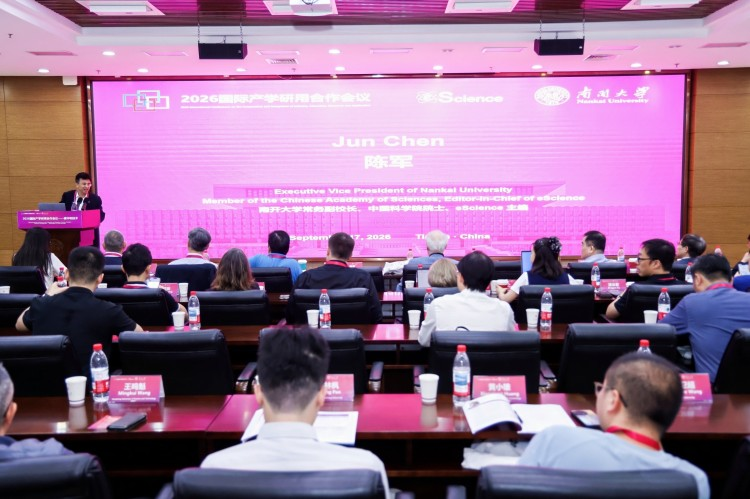
In his remarks, Chen Jun noted that the global energy transition is accelerating, and achieving carbon peaking and carbon neutrality represents a major strategic decision made by China in response to the inherent requirements of sustainable development. Technologies such as perovskite photovoltaics, hydrogen production through water splitting, and carbon dioxide conversion are important technological pathways for advancing green and low-carbon development. Guided by its educational mission of “knowing China and serving China”, Nankai University has continued to advance frontier research in new energy and carbon neutrality. By leveraging this international conference as a platform, Nankai University aims to promote the deep integration of basic research, cutting-edge technologies, and industrial applications, strengthen transnational and interdisciplinary collaborative innovation, and contribute its wisdom to global carbon neutrality efforts.
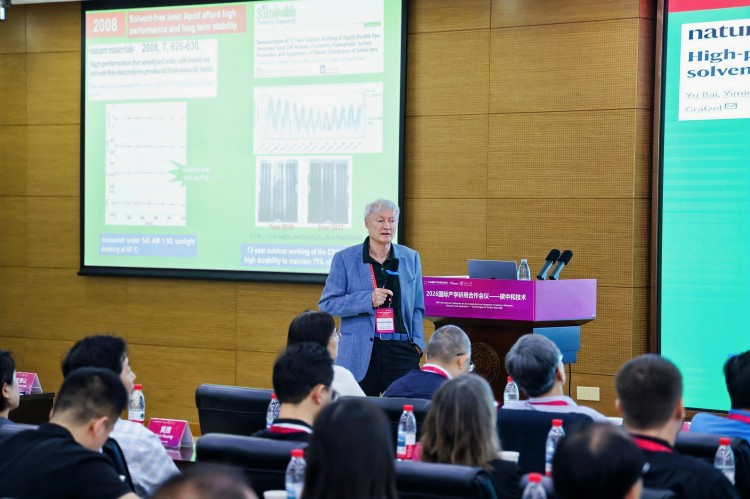
Michael Grätzel, Foreign Member of the Chinese Academy of Sciences and Professor at École Polytechnique Fédérale de Lausanne (EPFL), delivered the first keynote presentation at the conference. Focusing on perovskite solar cells as a transformative photovoltaic technology, he analyzed current challenges related to efficiency, stability, lead toxicity, and large-scale commercialization. He also introduced the latest research advances in molecular additive-assisted defect passivation, interface chemical engineering, and triple-junction tandem devices for CO₂ electrochemical conversion into syngas, formic acid, and ethylene.
The conference focused on cutting-edge fields including perovskite photovoltaics, hydrogen production through water splitting, and carbon dioxide reduction. Leading scientists from around the world delivered keynote presentations and shared their latest breakthroughs. Chen Yongsheng, an academician of the Chinese Academy of Sciences and professor at Nankai University, delivered a presentation on functional polymer materials for energy conversion and storage. Professor Jae Sung Lee from Ulsan National Institute of Science and Technology delivered a presentation focusing on perovskite/silicon tandem-based single photoelectrode modules and photoelectrochemical systems for practical solar-driven hydrogen production. Professor Qiao Shizhang from the University of Adelaide conducted materials innovation research in energy storage and conversion, sharing the latest advances in proton exchange membranes and hydrogen production from seawater using alkaline electrolyzers, while analyzing commercialization challenges and material solutions for aqueous zinc-based batteries and metal–sulfur batteries. Professor Alex Kwan Yue Jen from City University of Hong Kong introduced a cross-linked co-SAM hole transport layer strategy, which constructs two-dimensional/three-dimensional heterojunctions through buried-interface engineering and achieves a record-high open-circuit voltage for wide-bandgap perovskite solar cells. Professor Fan Hongjin from Nanyang Technological University presented his research on atomic-scale catalysis, showcasing synthesis strategies for electrocatalytic materials including biaxially strained two-dimensional materials, single-atom arrays, and high-entropy nanosheets, and discussing how nanoscale effects enhance intrinsic activity and enable data-driven catalyst discovery.
Some experts were invited to deliver presentations. They are: Hou Yi from the National University of Singapore; Marina Freitag from Newcastle University; Yu Jiaguo from China University of Geosciences; Zhu Yongfa from Anhui Normal University; Francesca M. Toma from Helmholtz Centers in Germany; Xu Bingjun from Peking University; Wang Guoxiong from Fudan University; Yanwei Lum from the National University of Singapore; Ji-Hyun Jang and Ji-Wook Jang from Ulsan National Institute of Science and Technology; Guo Shaojun from Peking University; Lu Tongbu from Tianjin University of Technology; Liu Jian from Inner Mongolia University; Brian Seger from the Technical University of Denmark; Wang Haotian from Rice University; Zhang Tierui from the Technical Institute of Physics and Chemistry, Chinese Academy of Sciences; and Luo Jingshan from Nankai University. The presentations covered key scientific issues including dynamic interface engineering for solar fuels, device-level cross-sectional Raman characterization, salt precipitation management during CO₂ electrolysis, practical strategies for artificial photosynthesis, and photoelectrode optimization. They shared multidimensional insights spanning atomic-scale catalysis, new material development, in situ characterization technologies, device scaling, system engineering, and industrialization challenges.
During the conference, faculty members and students actively engaged with the speakers. Discussions focused on topics including perovskite stability, enhancement of photocatalytic and electrocatalytic efficiency, large-scale manufacturing, translation of research outcomes into practical applications, and cultivation of young talent. Participants exchanged research progress on frontier issues in related fields and explored opportunities for future cooperation.
The International Conference on the Cooperation and Integration of Industry, Education, Research and Application was initiated by the Ministry of Education in 2018. The conference aims to respond to industrial needs, promote closer connections and collaboration among domestic and international universities, research institutions, and companies, and establish a platform for academic exchange, scientific cooperation, and the translation of research achievements into applications. By fostering coordinated development among multiple stakeholders across industry, education, research, and application sectors, the conference seeks to achieve mutual benefits and win-win outcomes. The hosting of this conference has further strengthened Nankai University’s international academic influence in carbon neutrality and new energy, and has laid a solid foundation for future international research collaboration, joint talent cultivation, and technology transfer.
(Edited and translated by Nankai News Team.)

38 Tongyan Road, Jinnan District, Tianjin, P.R.China 300350 94 Weijin Road, Nankai District, Tianjin, P.R.China 300071
Copyright: Nankai University All Rights Reserved