

Nankai University Team Develops World’s First Bionic Auditory Neural Interface
Opening a New Path for Auditory Restoration
Recently, a team led by Professor Xu Wentao from the College of Electronic Information and Optical Engineering at Nankai University developed the world’s first bionic auditory neural interface, opening a new technological pathway for auditory restoration through electronic substitution and restoration beyond conventional cochlear implants.
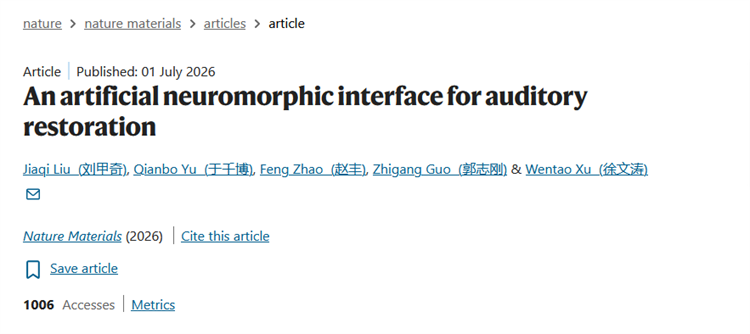
The team developed an artificial neuromorphic auditory interface capable of deep integration with the mammalian nervous system, creating a complete artificial auditory neural circuit that integrates acoustic signal acquisition, neuromorphic encoding, natural semantic information processing, and bioelectrical signal output. The study, titled “An Artificial Neuromorphic Interface for Auditory Restoration”, has been published in Nature Materials. Professor Xu Wentao is the sole corresponding author. Nankai University’s doctoral student Liu Jiaqi is the first author, with Yu Qianbo and Zhao Feng as co-first authors.
Data show that sensorineural hearing loss affects nearly 3% of the global population. Conventional cochlear implants can capture sound and convert it into electrical signals, but they still depend on a patient’s residual auditory nerves, rendering even the most advanced implants ineffective if these nerves are absent or severely damaged. To address this fundamental limitation, developing an artificial information transmission system that directly replaces the biological auditory nerve has long been a major focus of neural restoration research worldwide.
“Current cochlear implants primarily address the ability to ‘hear’. Because of limitations such as clock-driven signal processing and a limited number of electrodes, they still differ considerably from the natural auditory system in temporal resolution and speech recognition in complex environments,” Xu Wentao explained. “Our goal is not simply to enable an artificial auditory system to ‘hear’, but to allow it to ‘understand’, to filter, recognize, and process sounds in a manner analogous to the natural auditory system before transmitting useful information to the brain.”
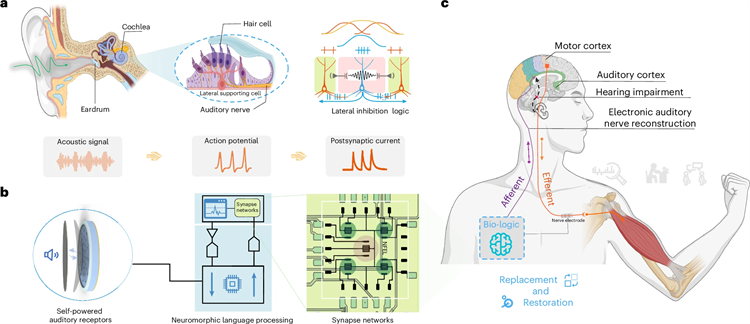
Figure: Schematic Diagram of the Artificial Neuromorphic Interface
To achieve this goal, the team developed a complete bionic neuromorphic interface for auditory restoration for the first time. The system integrates acoustic signal acquisition, neuromorphic encoding, natural semantic information processing, and bioelectrical signal output. It first mimics the cochlea to sense sound, and then emulates brain neural networks to filter and analyze acoustic signals. The processed information is subsequently converted into electrical pulses recognizable by biological nerves, enabling a stable connection with in vivo nerves and completing a closed loop from sound perception and information processing to neural transmission.
In simple terms, the system does more than simply “hear” sound. Like the natural auditory nerve, it can filter, analyze, and encode acoustic information, enabling the “artificial auditory nerve” to progress from “hearing” to “understanding”. This marks a critical step forward in auditory restoration, from restoring perception toward reconstructing function.
In animal experiments, deaf rabbits implanted with the team’s bionic auditory neural interface regained auditory perception, recognized different spoken commands, and completed corresponding behavioral tasks like “typing” and “ball-kicking”. These results demonstrate a complete artificial auditory information-processing pathway spanning from sound perception to semantic understanding and behavioral response, showing that the system has evolved from a simple sound transmitter into an intelligent processor mimicking the biological auditory nerve.
This achievement marks another original breakthrough by Professor Xu Wentao’s team in artificial neural systems over eight years of dedicated effort, following his 2018 landmark publication in Science on the world’s first flexible artificial tactile afferent nerve. It highlights Nankai University’s continued leadership at the global forefront of bionic neuroelectronics and neural restoration. Since returning to China in 2017, Xu Wentao has led sustained research on artificial neural systems and built a young research team of more than 40 members, with an average age of under 30. The team has progressively established a complete innovation chain spanning materials R&D, device fabrication, system integration, and biological validation, while developing an artificial neural technology framework covering visual, auditory, tactile, olfactory, and gustatory modalities. With independently developed intellectual property and a portfolio of core patents, the team has made the transition from participating in international collaborations to achieving original breakthroughs through its own research.
“Going forward, we will continue our research in neural restoration and bionic intelligence, accelerate the translation of core technologies into clinical applications and industrial development, and strive for more original breakthroughs in areas including neural prostheses, intelligent healthcare, brain–computer interfaces, and embodied intelligence. Through these efforts, we hope to contribute our expertise to advancing scientific and technological self-reliance and improving human health,” Xu Wentao said.
Link to the paper: https://www.nature.com/articles/s41563-026-02656-w
(Edited and translated by Nankai News Team.)

38 Tongyan Road, Jinnan District, Tianjin, P.R.China 300350 94 Weijin Road, Nankai District, Tianjin, P.R.China 300071
Copyright: Nankai University All Rights Reserved