


Nankai University Team Develops High-Quality Nickel Oxide, Laying a Solid Foundation for Tandem Photovoltaics
Driven by China’s “dual carbon” goals, all-perovskite tandem solar cells have attracted widespread attention because of their potential for both high efficiency and cost effectiveness. However, further improving device efficiency and long-term operational stability remains a major challenge to their industrialization. Recently, a team led by Research Fellow Li Yuelong from the College of Electronic Information and Optical Engineering at Nankai University made important progress in buried-interface engineering for perovskite solar cells. By introducing potassium dihydrogen phosphate (KH₂PO₄) as an additive to a nickel oxide (NiOₓ) dispersion, the team developed a new strategy for constructing efficient and stable perovskite photovoltaic devices. The work has been published in Energy & Environmental Science under the title “Homogenizing Buried Contact via pH-Modulated NiOX for High-Performance All-Perovskite Tandem Solar Cells”.
In inverted perovskite solar cells, nickel oxide serves as an important hole-transporting material. However, NiOₓ nanoparticles tend to aggregate during processing, resulting in nanoscale inhomogeneous films that make it difficult for the subsequently deposited self-assembled monolayer (SAM) to spread uniformly across the surface—much like laying tiles on an uneven road, where a flat, gap-free layer is difficult to achieve. Such interfacial defects increase carrier losses at the interface, thereby compromising device efficiency and stability.
Although a variety of optimization strategies, including doping and passivation, have been reported, these approaches are relatively complex and do not fundamentally resolve the spontaneous aggregation of NiOₓ nanoparticles during precursor synthesis and dispersion. To address this bottleneck, the team innovatively introduced KH₂PO₄ as an additive in the NiOₓ dispersion. By modulating the solution pH, the team achieved precise control over both the dispersion state and surface chemistry of the NiOₓ nanoparticles, suppressing aggregation at the source and producing highly dispersed NiOₓ nanoparticles with a size of about 5.6 nm. The resulting KH₂PO₄-NiOₓ films exhibited smaller grain sizes, higher surface coverage, and improved conductivity, enabling uniform and stable SAM anchoring. This in turn effectively suppressed interfacial carrier recombination and facilitated smoother transport of photogenerated charges. Devices fabricated using this approach achieved higher photoelectric conversion efficiency and maintained excellent stability during long-term operation, offering a new solution for interface engineering in perovskite photovoltaic devices.
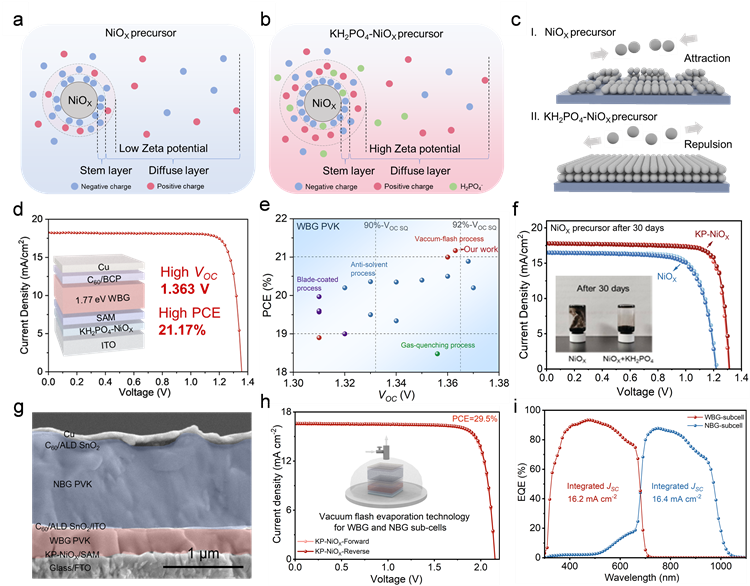
Figure 1. (a–c) Mechanism by which potassium dihydrogen phosphate dispersant suppresses the self-agglomeration of nickel oxide; (d–f) Performance of single-junction wide-bandgap perovskite solar cell devices; (g–i) Performance of all-perovskite tandem solar cell devices;
“All-perovskite tandem solar cells fabricated using this technology offer the advantages of high efficiency and cost effectiveness, and light weight, and therefore hold broad application prospects,” said Li Yuelong. He added that the team would continue advancing the research and development of all-perovskite tandem solar cells, with the goal of moving these findings from the laboratory toward broader real-world applications, including flexible wearable devices, building-integrated photovoltaics, and aerospace photovoltaics.
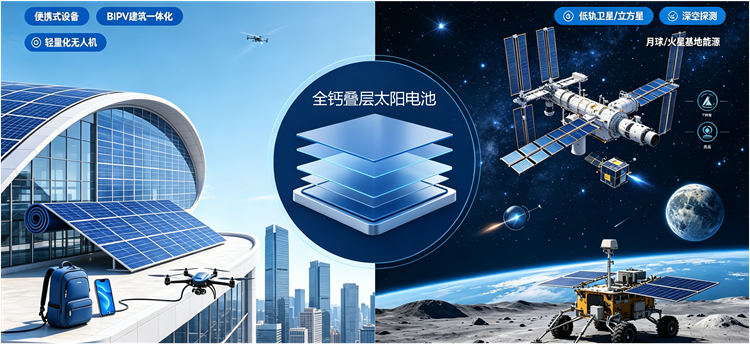
Figure 2. Application scenarios for all-perovskite tandem solar cells (AI-generated image)
This work was carried out jointly by Nankai University, the Hong Kong University of Science and Technology (Guangzhou), Sungkyunkwan University, and the CATL 21C Innovation Lab. Nankai University is the first affiliation of the paper. Zhang Zemin and Zhang Xinpeng, both doctoral students at Nankai University’s College of Electronic Information and Optical Engineering, are co-first authors of the paper, and Research Fellow Li Yuelong is the corresponding author.
Link to the paper: https://doi.org/10.1039/D6EE02093C
(Edited and translated by Nankai News Team.)

38 Tongyan Road, Jinnan District, Tianjin, P.R.China 300350 94 Weijin Road, Nankai District, Tianjin, P.R.China 300071
Copyright: Nankai University All Rights Reserved