


Nankai University Team Releases the Chinese Private Enterprises Outward Foreign Direct Investment Index (2025)
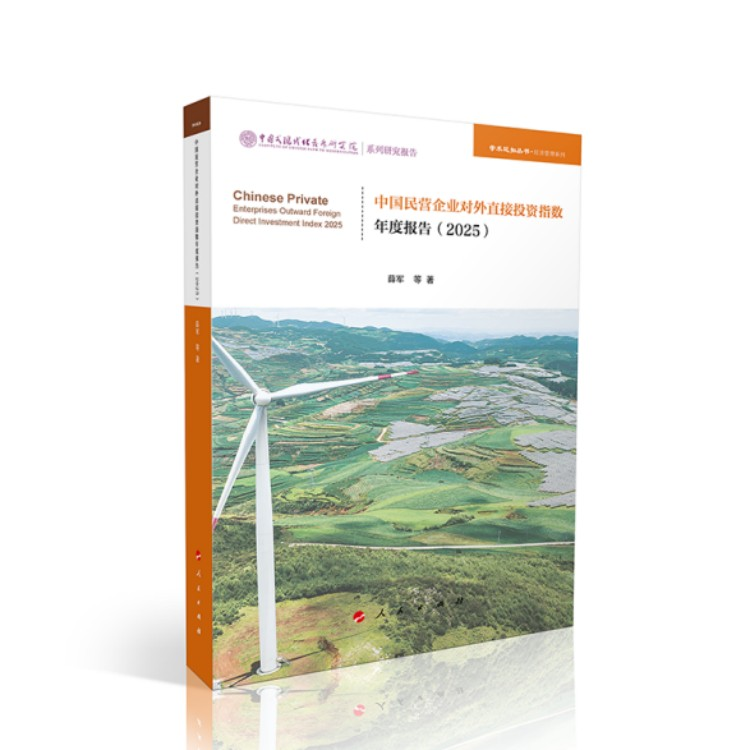
Recently, the Chinese Private Enterprises Outward Foreign Direct Investment Index (2025), compiled by the research team led by Professor Xue Jun from Nankai University’s School of Economics, was officially released. This marks the ninth edition since its first release in 2017. Building on the existing database, this report has been revised and upgraded. In addition to its continued focus on parent companies’ outward foreign direct investment (PC-OFDI), this report introduces a new quality-indicator system reflecting the business performance of overseas subsidiaries (OSBP). The system covers key dimensions including the geographic distribution of overseas subsidiaries, local employment, sales, profit margins, and R&D, providing a comprehensive analysis of the characteristics of a new stage in the high-quality development of Chinese enterprises’ overseas investment.
Composite data estimates show that Chinese private enterprises not only maintain a dominant position in the nation’s outbound investment, but have also achieved remarkable results in improving investment quality and operational efficiency. Between 2005 and 2024, the share of PC-OFDI projects and investment value in the national total rose sharply. Meanwhile, the composite index of the OSBP grew nearly tenfold over the past two decades—a sustained leap that indicates Chinese private enterprises’ outbound expansion is shifting from scale-driven growth to a model that also emphasizes efficiency gains.
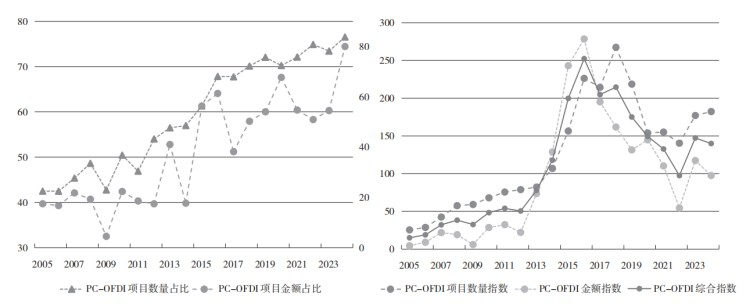
In terms of investment models and industrial landscape, Chinese private enterprises have demonstrated strong expansion dynamism and technological sophistication. Greenfield investment posted strong and rapid growth, with its composite index climbing to 397.53 in 2024. Outward investment by Chinese private enterprises has become increasingly concentrated in high-tech manufacturing and asset-light service industries. The overseas R&D expenditure index, for example, increased more than fivefold, while high-tech manufacturing industries such as pharmaceutical manufacturing and computer equipment recorded particularly strong returns on assets. Chinese private enterprises have also achieved substantial results in their investment and operations along the Belt and Road. Both the number and value of their investment projects accounted for more than 75% of China’s total investment along the Belt and Road, and the OSBP index rose from 41.85 to 879.26. Large-scale private enterprises played a leading role in this process. In non-manufacturing sectors, their overseas sales revenue accounted for more than 80% of local market sales, reflecting their deep integration into local markets and their contribution to local economic development.
Looking ahead, guided by the three principles of being “globally unique, statistical yearbook-style, and sustainable”, Professor Xue Jun’s team will strive to build the “Nankai China OFDI Index” into a high-quality and trustworthy brand. This annual report series, with its expanding research scope, combines the objectivity of a statistical yearbook with a think-tank function that supports the high-quality international development of Chinese private enterprises. The team will also work to elevate the analysis of current conditions to a higher level of theoretical research, providing important theoretical foundations and practical guidance for establishing a sustainable, long-term mechanism for Chinese private enterprises to “go global”.
(Edited and translated by Nankai News Team.)

38 Tongyan Road, Jinnan District, Tianjin, P.R.China 300350 94 Weijin Road, Nankai District, Tianjin, P.R.China 300071
Copyright: Nankai University All Rights Reserved