


Nankai University Team Achieves Machine Learning-Assisted Rapid and Scalable Synthesis of Metal-Oxo Clusters for Photoresists
Metal-oxo clusters, characterized by atomically precise structures and tunable compositions and properties, hold considerable promise for applications in catalysis, energy, and advanced lithography. Recently, a team led by Professor Zhang Lei at the Institute of Modern Optics, Nankai University, fabricated ultra-small structures with sub-10 nm features through precise structural design, further demonstrating the potential of these materials for next-generation advanced lithography. While, the controlled synthesis of metal-oxo clusters is often complicated by multiple competing reaction pathways and the complex interplay among reaction parameters. Conventional synthesis relies heavily on trial-and-error experimentation, which is not only inefficient but also difficult to scale up, limiting the broader industrial application of these materials.
To address this challenge, Professor Zhang Lei’s team developed a machine learning-assisted reaction-space optimization strategy. By combining data-driven modeling with model interpretability analysis, the team identified an effective reaction window and successfully synthesized a new Sn12Ti4 oxo cluster capable of sub-10-nm resolution. The strategy provides a new route for the efficient synthesis ofadvanced lithography materials. The study, titled “Machine Learning-Assisted Rapid Scalable Synthesis and Assembly Evolution of Lithographic Metal-Oxo Clusters”, has been published in Journal of the American Chemical Society.
The research team first converted published experimental synthesis data on tin-oxo cluster into a structured dataset to train machine learningmodels. By applying model interpretability analysis, they indentified the key factors governing tin-oxo cluster synthesis, substantially narrowing the parameter search space and providing valuable insights for subsequent targeted synthesis experiments. Experimental results showed that the synthesized Sn12Ti4 oxo cluster exhibited exceptionally rapid crystallization: under stirring at room temperature, high-quality single-crystal products formed within seconds of reactant mixing. Scale-up experiments demonstrated that 266 grams of high-purity crystalline sample could be prepared in just 15 minutes, highlighting its strong potential for scalable synthesis.
The research team further discovered that tuning the steric and electronic properties of terminal ligands enables the structural evolution of the oxo cluster from zero-dimensional discrete units into two- and three-dimensional supramolecular architectures, as well as three-dimensional chiral frameworks. In addition, the Sn12Ti4 oxo cluster demonstrated exceptional potential for high-resolution lithography, achieving 9.83-nm patterning under electron-beam exposure, which holds promise for providing a new material platform for the development of next-generation high-performance photoresists.
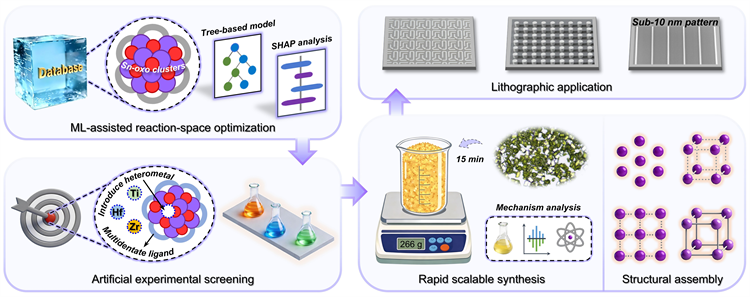
Machine learning-assisted reaction-space optimization enables rapid and scalable synthesis of metal-oxo clusters for ultrafine nanopatterning applications
This work provides a new route for the rapid and scalable synthesis of high-performance metal-oxo clusters for photoresists, while demonstrating the potential of AI-assisted approaches for chemical synthesis and advanced material development.
The first author of this paper is Zhao Huifang, a doctoral student of the Class of 2024 at Nankai University, and the corresponding authors are Zhang Lei, Yun Yihan, and Zhen Ni.
Link to the paper: https://pubs.acs.org/doi/10.1021/jacs.6c07843
(Edited and translated by Nankai News Team.)

38 Tongyan Road, Jinnan District, Tianjin, P.R.China 300350 94 Weijin Road, Nankai District, Tianjin, P.R.China 300071
Copyright: Nankai University All Rights Reserved