
Nankai University and Sungkyunkwan University Sign Research Collaboration Agreement
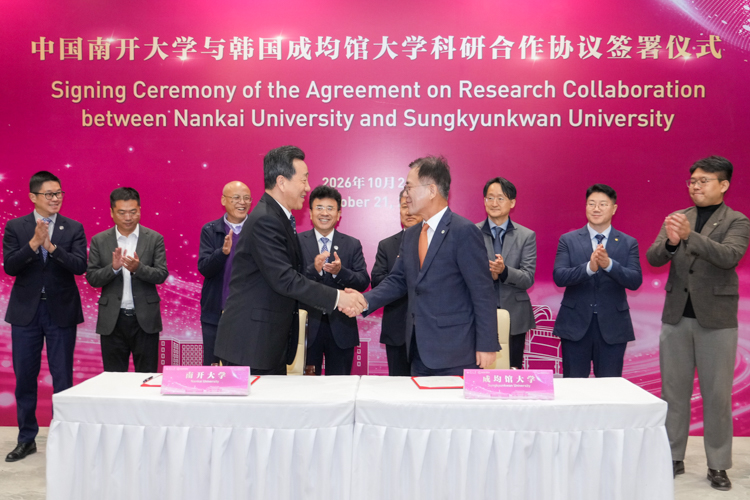
On October 21, Nankai University and Sungkyunkwan University (SKKU) held a ceremony at Haibing Center on Balitai Campus to sign an agreement on research collaboration. Yang Qingshan, Secretary of the CPC Nankai University Committee, and Ji-Beom Yoo, President of SKKU, signed the agreement on behalf of their respective universities. Chen Jun, an academician of the Chinese Academy of Sciences and Executive Vice President of Nankai University, presided over the ceremony. Chen Yongsheng, an academician of the Chinese Academy of Sciences and professor at College of Chemistry, attended and witnessed the signing.
Under the agreement, the two universities will leverage their respective disciplinary strengths to deepen research cooperation, carry out joint research in areas of shared interest, and translate research collaboration at multiple levels into concrete outcomes.
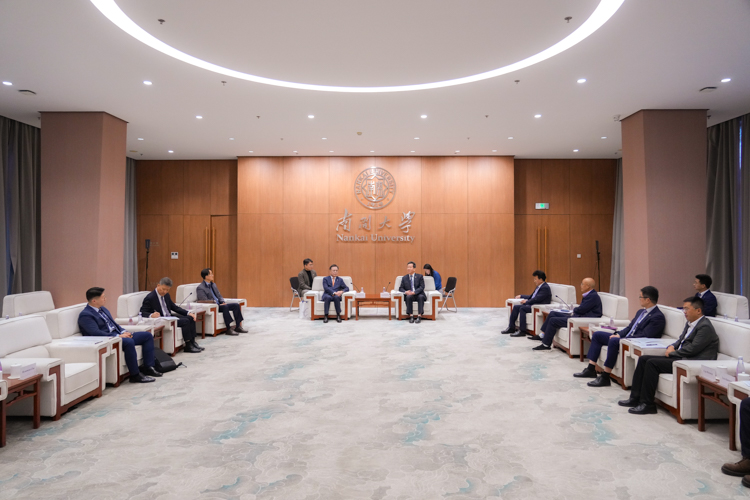
The two sides held talks before the signing ceremony.
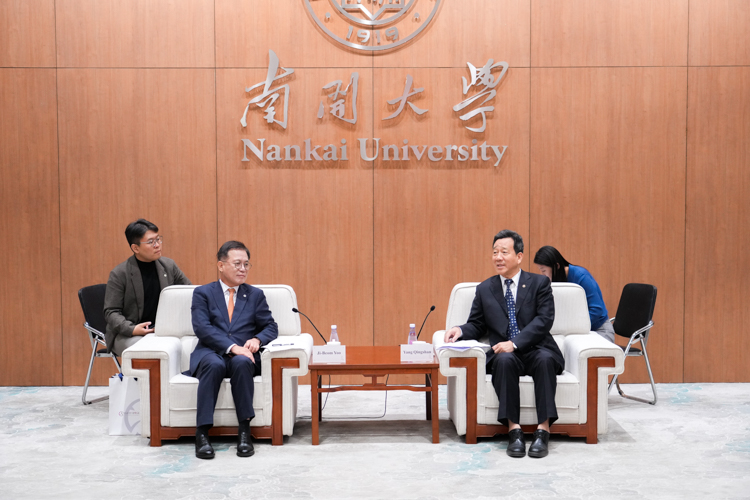
Yang Qingshan welcomed President Yoo and his delegation and introduced Nankai University’s history and disciplinary strengths. He noted that since establishing cooperative ties in 2002, the two universities have engaged in extensive and practical cooperation through faculty and student exchanges, academic interactions and joint research. The signing is both a continuation of their longstanding friendship and a new starting point for deepening their partnership and pursuing mutually beneficial development. Looking ahead, he hoped the two universities would deepen cooperation in areas of research strength such as chemistry and materials science, undertake joint research on scientific challenges, organize academic seminars and jointly cultivate research talent. He also encouraged expanded student training opportunities and exchanges among early-career faculty through short-term programs, summer schools and joint courses, thereby fostering closer ties between young people in the two countries. Building on their complementary disciplinary strengths, the two universities could jointly establish high-level international platforms for collaborative innovation, tackle major scientific problems and overcome key technological barriers. Through sustained and substantive cooperation, they could yield fruitful results and contribute to China–South Korea higher education exchanges and scientific and technological innovation.
President Yoo thanked Nankai University for its warm hospitality and introduced SKKU’s scale, disciplinary structure and research development. He described Nankai University as a globally respected university with a rich academic heritage and rigorous scholarly traditions. Since establishing ties, the two universities have maintained close exchanges and mutual trust, building a solid foundation for cooperation in joint research as well as faculty and student exchanges. SKKU places great value on its partnership with Nankai University and hopes the new agreement will open the door to broader collaboration. The two institutions could strengthen joint research in STEM areas such as nanomaterials, while deepening dialogue and mutual learning in the humanities. He also called for more diverse talent cultivation programs and wider channels for faculty and student exchanges to jointly nurture outstanding graduates with an international outlook and produce high-quality, influential collaborative outcomes. Together, the universities could set a new example of mutual learning and coordinated development between Chinese and South Korean higher education institutions.
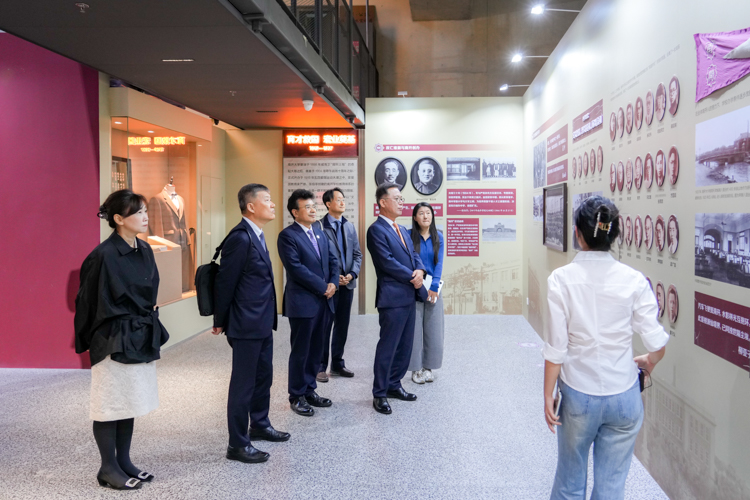
Later that day, President Yoo and his delegation also visited the Nankai University History Exhibition, learning about the university’s century-long history of education, talent cultivation and perseverance. The two sides also held a working meeting for in-depth discussions on international joint research and other topics.
(Edited and translated by Nankai News Team.)

38 Tongyan Road, Jinnan District, Tianjin, P.R.China 300350 94 Weijin Road, Nankai District, Tianjin, P.R.China 300071
Copyright: Nankai University All Rights Reserved