


Fauna Sinica Insecta Miridae (IV) Published
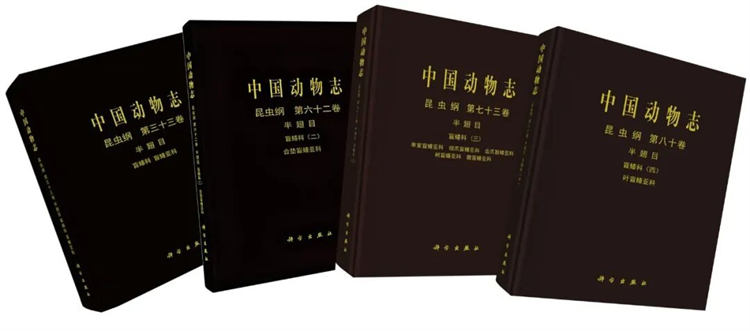
A volume titled Fauna Sinica Insecta Vol.80 Hemiptera Miridae (IV) Phylinae, compiled by a team of faculty members from Nankai University's College of Life Sciences, has recently been published, marking the completion of the four-volume Miridae series in the Insecta volumes of Fauna Sinica. Together, the four volumes document 1,049 species in 222 genera of Miridae found in China, providing a systematic survey and comprehensive account of the country's plant bug diversity.
Taxonomic research on Miridae in China began in the 1940s, pioneered by the renowned entomologist Professor Tsai-Yu Hsiao. He earned his PhD from Iowa State University in the US in 1941 and was appointed professor and chair of the Department of Biology at Nankai University in 1946. He subsequently established an entomology teaching and research group and was among the first in China to conduct taxonomic studies of Miridae and related insect groups. His extensive research achievements and the valuable specimens and data he accumulated laid a solid foundation for the later compilation of the Miridae volumes of Fauna Sinica.
Professor Zheng Leyi, a distinguished Chinese entomologist, studied under Professor Tsai-Yu Hsiao. He devoted many years to research and teaching of the Hemiptera of China, leading the Nankai University team in conducting in-depth taxonomic studies of Miridae and led the compilation of the first Miridae volume of Fauna Sinica. Professor Liu Guoqing, who studied under Professor Zheng Leyi and earned his PhD from Nankai University, has likewise devoted himself to Miridae taxonomy. He led the compilation of the subsequent three volumes.
Over the decades, the Nankai University team has collected nearly one million specimens through field surveys across China. These efforts reflect the dedication, wisdom and unwavering commitment of four generations of taxonomists over more than half a century.
Fauna Sinica serves as an important reference for research and teaching in entomology, zoology, agronomy and related fields. It is also useful for departments and service agencies involved in agriculture and forestry, biological control, and health quarantine, as well as for science communication. As an authoritative reference work of considerable academic and practical value, it provides solid and reliable foundational reference material for researchers, university faculty and students, and professionals in related industries.
(Edited and translated by Nankai News Team.)

38 Tongyan Road, Jinnan District, Tianjin, P.R.China 300350 94 Weijin Road, Nankai District, Tianjin, P.R.China 300071
Copyright: Nankai University All Rights Reserved